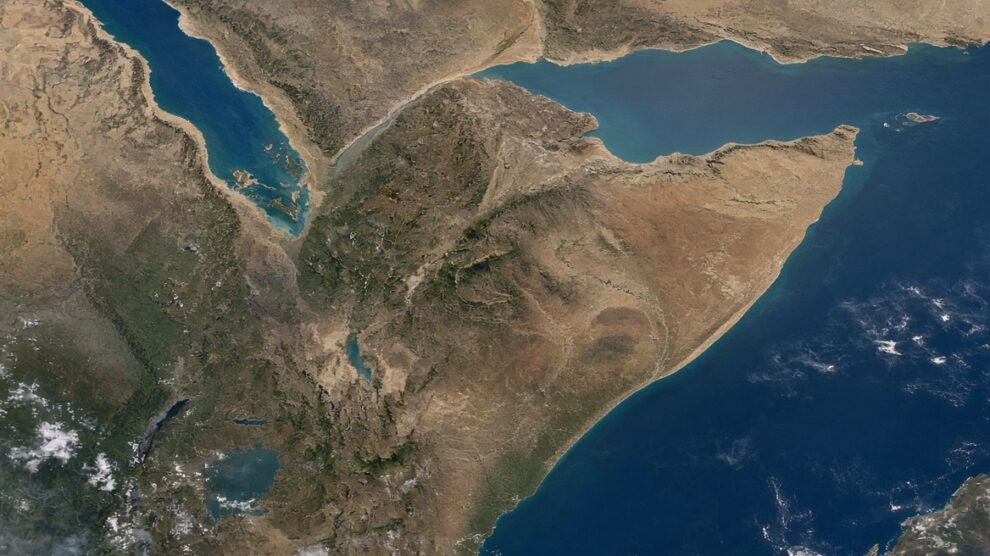
Ethiopia’s military advances in Tigray have raised fears of a wider confrontation with neighboring Eritrea, potentially bringing Addis Ababa’s longstanding ambitions for Red Sea access into an increasingly volatile military equation.
What is happening: Ethiopian government-allied forces have regained control of Mekelle, Tigray’s regional capital, following the withdrawal of fighters from the Tigray People’s Liberation Front (TPLF). Federal troops have also advanced toward the Eritrean border, reaching Zalambessa on October 13.
- Addis Ababa has accused Eritrea of sending troops into Ethiopian territory and supporting insurgents, allegations Asmara rejects. Eritrea, in turn, has accused Ethiopia of preparing for war, amid concerns that the confrontation could eventually involve Assab, its strategically located Red Sea port.
- The escalation has prompted diplomatic intervention from Washington. On October 14, US Secretary of State Marco Rubio spoke with Ethiopian Prime Minister Abiy Ahmed, urging restraint, dialogue and respect for territorial sovereignty. Human Rights Watch has meanwhile reported civilian casualties from shelling in southern Tigray.
Why it matters: A confrontation between Ethiopia and Eritrea would open another front of instability along a maritime corridor already exposed to significant geopolitical and geoeconomic pressures, potentially adding further stress to international trade and regional security.
- The 2022 Pretoria Agreement ended two years of devastating warfare in Tigray but left fundamental political and territorial disputes unresolved. Its incomplete implementation, alongside deteriorating relations between Ethiopia and Eritrea, has weakened regional stability.
- Landlocked since Eritrea’s independence in 1993, Ethiopia has increasingly presented access to the Red Sea as essential to its economic development and national security. Abiy’s maritime ambitions have consequently become a central concern for Asmara, where Assab represents both a sovereign asset and a strategic vulnerability.
- Although an Ethiopian offensive toward the port remains an unconfirmed scenario, the convergence of territorial disputes and competing strategic ambitions creates a dangerous escalation pathway.
The bigger picture: The Horn of Africa crisis is unfolding within an increasingly fragmented Red Sea security environment, where regional conflicts and maritime vulnerabilities are becoming more closely intertwined.
- Across the Bab el-Mandeb Strait, Yemen’s Iran-backed Houthis have demonstrated their ability to disrupt international shipping, linking maritime insecurity to the broader confrontation involving Israel, Gaza and Iran. Further east, tensions surrounding the Strait of Hormuz continue to expose Gulf energy exports and international trade to regional escalation.
- These crises have distinct origins and dynamics, but their cumulative effects threaten an interconnected maritime system linking the Persian Gulf, the Indian Ocean and the Mediterranean.
The risks: A renewed Ethiopia-Eritrea war would introduce a different category of risk: interstate confrontation along the African coastline, potentially destabilizing a region where Gulf powers have developed significant strategic interests through ports, infrastructure investments and security partnerships.
- The United Arab Emirates and Saudi Arabia have expanded their engagement across the Horn, while Djibouti remains a critical global hub for international military deployments and commercial shipping. A confrontation over Assab could therefore affect the calculations of neighboring states and external powers operating around the Red Sea, further complicating an already fragile regional balance.
The Italian angle: The Horn of Africa has historically occupied a significant place in Italy’s foreign policy, reflecting longstanding political, economic and historical ties with Ethiopia, Eritrea and Somalia.
- This engagement has gained renewed momentum under Prime Minister Giorgia Meloni, whose government has placed Ethiopia at the center of its Africa strategy and the Mattei Plan. Between 2023 and 2025, Meloni met Abiy Ahmed seven times, reflecting the importance Rome attaches to its relationship with Addis Ababa. Italy has simultaneously pursued closer cooperation with Eritrea, giving it diplomatic interests on both sides of the emerging confrontation.
The stakes extend well beyond bilateral relations. As a major European manufacturing and trading economy, Italy depends heavily on maritime connections through the Mediterranean, Suez Canal and Red Sea for its commercial exchanges with Asian markets.
- The disruption caused by Houthi attacks has demonstrated how quickly a critical maritime corridor can become effectively inaccessible to commercial shipping, reinforcing the strategic urgency of developing alternative connectivity routes.
In this context, implementing the India-Middle East-Europe Economic Corridor (IMEC) has become increasingly important for Rome. Launched in 2023, before the Red Sea shipping crisis, the initiative offers an opportunity to introduce greater redundancy and resilience into trade networks connecting Europe, the Middle East and Asia.
- The objective is not to replace existing maritime routes, but to reduce excessive dependence on vulnerable chokepoints. The Red Sea crisis has made this diversification a matter of strategic security rather than simply economic efficiency.
What to watch: Whether Ethiopian military operations remain confined to Tigray or evolve into direct confrontation with Eritrea will determine the immediate trajectory of the crisis.
- The broader danger is that the erosion of the Pretoria settlement could transform a fragile domestic peace into another source of regional instability, further complicating the security environment surrounding the Red Sea.
The bottom Line: Naval deployments can help protect commercial shipping against immediate threats, but they cannot resolve the political and territorial disputes destabilizing the surrounding coastline.
- The Red Sea’s security challenge increasingly extends beyond keeping shipping lanes open. It also depends on preventing the conflicts along its shores from reinforcing the vulnerabilities of an already contested maritime system.