Dehai News

Eritrea issues statement on Ethiopia's port demand and geopolitical analysis

Posted by: Semere Asmelash

Date: Monday, 27 July 2026

Eritrea issues statement on Ethiopia's port demand and geopolitical analysis

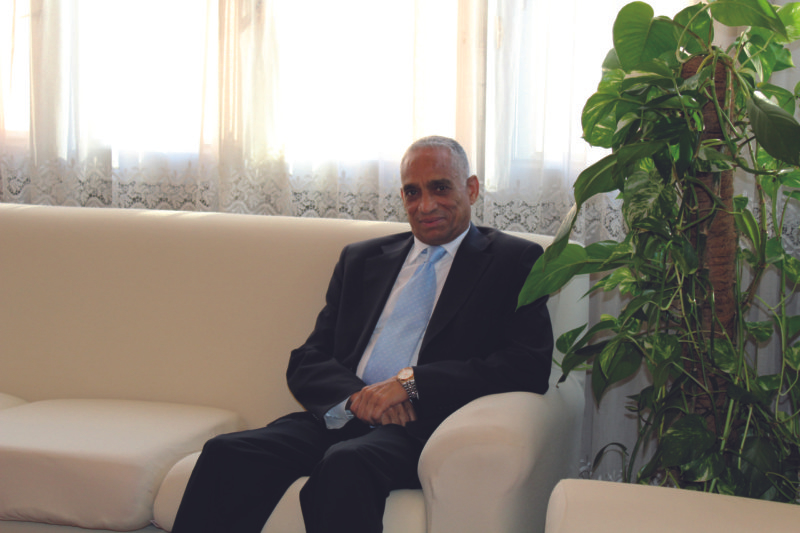
Eritrean Ambassador to Italy Fessahazion Pietros.

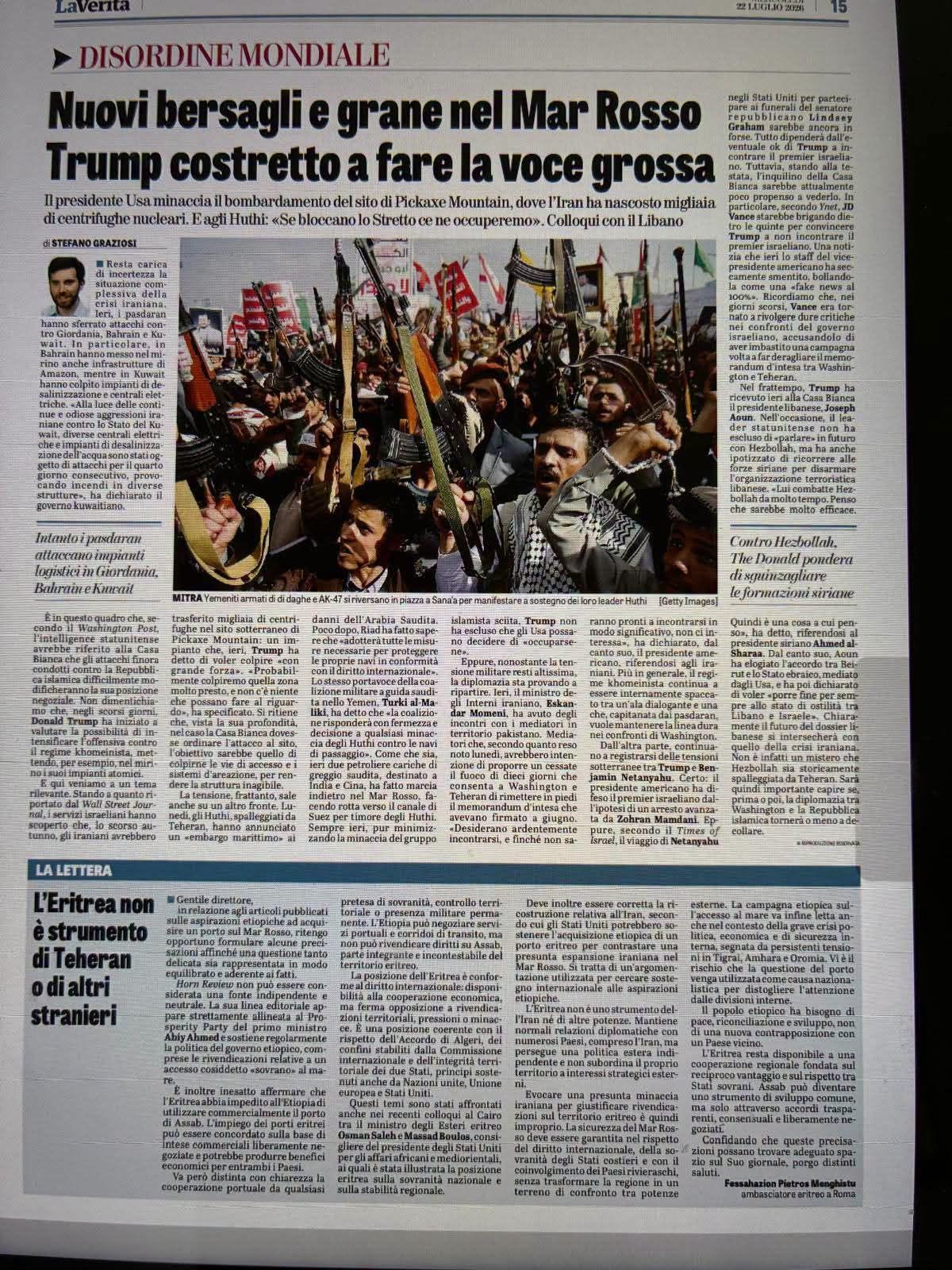
The Italian newspaper La Verità has reported that the Eritrean government has articulated a strong and comprehensive position regarding Ethiopia's claims concerning port ownership and associated geopolitical analyses.

In an extensive letter of clarification sent to the prominent Italian newspaper, Eritrea’s Ambassador to Rome, Fessahazion Pietros Menghistu, emphasized that Eritrea is not a country that falls under the strategic influence of any power and categorically rejects any demands on its sovereignty.

At the outset of his letter, the ambassador noted that media outlets such as Horn Review cannot be considered neutral or independent sources, as they are fully aligned with the Ethiopian government.

He pointed out that these entities consistently echo the policies of the Ethiopian administration and its pursuit of a so-called "sovereign" port access, ensuring the issue is framed through biased narratives.

Furthermore, the ambassador dismissed as entirely false the allegation that Eritrea has prevented Ethiopia from commercially utilizing the port of Assab.

He explained that Eritrean ports can be engaged for commercial use exclusively through freely negotiated bilateral trade agreements founded on mutual economic benefits.

However, he underscored that port cooperation must be strictly separated from any claims of sovereignty or territorial control.While Ethiopia may negotiate commercial port services and transit corridors, it cannot assert rights of ownership over Assab, which remains an integral and inviolable part of Eritrean territory.

Stating that Eritrea's foreign policy fully aligns with international law, Ambassador Fessahazion reiterated that while his country remains permanently open to economic cooperation, it offers fierce resistance to territorial demands, pressures, or threats.

He stressed that this principled stance respects the Algiers Agreement, the boundaries established by the international boundary commission, and the territorial integrity of both states principles likewise endorsed by the United Nations, the European Union, and the United States.

Addressing another point, the text corrected the erroneous analysis suggesting the United States might back Ethiopian acquisition of an Eritrean port to counter perceived Iranian expansion in the Red Sea.

The ambassador affirmed that Eritrea is neither an instrument nor a proxy for Iran or any other external power. He clarified that while Eritrea maintains normal diplomatic relations with numerous nations, including Iran; it pursues an independent foreign policy and refuses to subordinate its territory to foreign strategic interests.

He cautioned that regional security and peace in the Red Sea must be anchored in respect for the sovereignty of coastal states and the exclusion of foreign interference, rather than transforming the region into a theater of confrontation for outside powers.

Concluding his message, the ambassador stated that the Ethiopian people require peace, reconciliation, and development rather than fresh confrontation with a neighbor.

 He added that Assab can serve as an instrument for shared development, provided it is pursued purely through transparent and mutually agreed-upon trade frameworks rather than coercion.

Against this backdrop, it is recalled that as diplomatic tensions escalate over the Red Sea and port ownership, the Ethiopian government has underscored that national interest stands as an uncompromisable "red line" surpassing any negotiation.

It was also noted that safeguarding national interests is not a matter of transient politics or partisan alignment, but a collective agenda determining the survival and future destiny of the citizens.

Eritrea issues statement on Ethiopia's port demand and ...

Fes­sa­ha­zion Pie­tros Men­ghi­stu | 𝘌𝘳𝘪𝘵𝘳𝘦𝘢𝘯 𝘈𝘮𝘣𝘢𝘴𝘴𝘢𝘥𝘰𝘳 𝘵𝘰 𝘙𝘰𝘮𝘦
THE LETTER
𝗘𝗿𝗶𝘁𝗿𝗲𝗮 𝗶𝘀 𝗻𝗼𝘁 𝗮 𝘁𝗼𝗼𝗹 𝗼𝗳 𝗧𝗲𝗵𝗿𝗮𝗻 𝗼𝗿 𝗮𝗻𝘆 𝗼𝘁𝗵𝗲𝗿 𝗳𝗼𝗿𝗲𝗶𝗴𝗻 𝗽𝗼𝘄𝗲𝗿
Dear Editor,
With reference to the articles published on Ethiopia's aspirations to acquire a port on the Red Sea, I believe it is appropriate to make a number of clarifications so that such a sensitive issue is presented in a balanced manner and in accordance with the facts.
Horn Review cannot be regarded as an independent and neutral source. Its editorial line appears to be closely aligned with Prime Minister Abiy Ahmed's Prosperity Party and consistently supports the Ethiopian government's policies, including its claims for what it calls "sovereign" access to the sea.
It is also incorrect to state that Eritrea has prevented Ethiopia from making commercial use of the Port of Assab. The use of Eritrean ports can be agreed upon through freely negotiated commercial arrangements and could provide economic benefits for both countries.
However, there must be a clear distinction between port cooperation and any claim of sovereignty, territorial control, or permanent military presence. Ethiopia may negotiate port services and transit corridors, but it cannot claim rights over Assab, which is an integral and indisputable part of Eritrean territory.
Eritrea's position is consistent with international law: it is open to economic cooperation but firmly opposes territorial claims, pressure, or threats. This position is consistent with respect for the Algiers Agreement, the boundaries established by the Eritrea-Ethiopia Boundary Commission, and the territorial integrity of both states, principles also supported by the United Nations, the European Union, and the United States.
These issues were also discussed during the recent talks in Cairo between Eritrean Foreign Minister Osman Saleh and Massad Boulos, the U.S. President's Senior Adviser for African and Middle Eastern Affairs, during which Eritrea's position on national sovereignty and regional stability was presented.
The narrative concerning Iran also needs to be corrected. It has been suggested that the United States might support Ethiopia's acquisition of an Eritrean port to counter an alleged Iranian expansion in the Red Sea. This is an argument used in an attempt to gain international backing for Ethiopia's aspirations.
Eritrea is not an instrument of Iran or any other power. It maintains normal diplomatic relations with many countries, including Iran, but pursues an independent foreign policy and does not subordinate its territory to the strategic interests of external powers.
Invoking an alleged Iranian threat to justify claims over Eritrean territory is therefore inappropriate. Security in the Red Sea must be ensured in accordance with international law, with respect for the sovereignty of the coastal states, and through the involvement of the countries bordering the sea, without turning the region into an arena for competition among external powers.
Finally, Ethiopia's campaign for access to the sea should also be viewed in the context of its severe domestic political, economic, and security crisis, marked by continuing tensions in Tigray, Amhara, and Oromia. There is a risk that the port issue is being used as a nationalist cause to divert attention from internal divisions.
The Ethiopian people need peace, reconciliation, and development, not a new confrontation with a neighboring country.
Eritrea remains ready for regional cooperation based on mutual benefit and respect among sovereign states. Assab can become an instrument of shared development, but only through transparent, consensual, and freely negotiated agreements.
Trusting that these clarifications will find appropriate space in your newspaper, I extend my respectful regards.
𝗙𝗲𝘀𝘀𝗮𝗵𝗮𝘇𝗶𝗼𝗻 𝗣𝗶𝗲𝘁𝗿𝗼𝘀 𝗠𝗲𝗻𝗴𝗵𝗶𝘀𝘁𝘂
𝘌𝘳𝘪𝘵𝘳𝘦𝘢𝘯 𝘈𝘮𝘣𝘢𝘴𝘴𝘢𝘥𝘰𝘳 𝘵𝘰 𝘙𝘰𝘮𝘦

L'Eritrea non è strumento di Teheran o di altri stranieri


Inline image


My vision for Eritrea: using the power of mathematics to inspire innovation, education, and nation-building. Let’s build a stronger future together.

Dehai Events